Most small businesses need five purposeful pages: Home, About, Services or Products, Contact, and a Blog or FAQ. I’ve seen seven well-built pages outperform fifty-page sites that chase keywords nobody searches for. Start lean and plan for growth—you’ll know you’re ready for more when your traffic climbs above 1,000 monthly visitors and your contact forms start backing up. Quality aligned with intent beats volume every time, and there’s more to unpack about what those pages should actually do.
TLDR
- Most small businesses launch successfully with five to ten carefully planned pages.
- Quality and user intent alignment matter far more than total page volume.
- Five core pages—Home, About, Services, Contact, Blog—form a complete foundation.
- Well-mapped pages outperform bloated sites when visitor intent is properly matched.
- Start lean with growth-ready structure to avoid costly future rebuilding.
What “Pages” Actually Means (and What It Doesn’t)

A page, in the technical sense, has its own unique URL and stands alone as a destination. You’ll confuse it with components like headers or footers that repeat everywhere. I’ve seen businesses obsess over page count when they should focus on purposeful, distinct destinations. Think Home, About, Services—not decorative elements that happen to sit on multiple pages. That’s your starting point. Impressions vs clicks communicates your brand, product, and service differentiation to potential customers, making each distinct destination work harder for your business.
The 5-Page Foundation That Handles 90% of Small Business Needs
Where do you actually start when you’re building a small business website without drowning in scope creep? I’ve built hundreds of these, and here’s what works: five pages. You need a Homepage that sells, an About page that builds trust, Services or Products pages that convert, a Contact page that removes friction, and a Blog or FAQ for ongoing value. That’s it.
I’ve seen businesses launch with twenty pages and zero traffic, while lean five-page sites rank and convert within weeks. Don’t let perfect be the enemy of profitable. Plus, your Homepage must make easily findable contact details and a clear call-to-action to keep visitors engaged from the first impression. You should also focus on realistic timelines for SEO so you know when to expect measurable results.
How Many Pages Do Most Small Business Websites Really Have?

Why do so many small business owners assume they need a sprawling website to compete? I’ve audited hundreds of sites, and most small businesses launch with 5–10 pages. You’d be surprised how many stagnate, never expanding because they confuse busywork with strategy. I’ve seen 7-page sites outperform 50-page ones when those seven actually serve customer intent. Volume rarely equals value. Top search rankings don’t always bring valuable traffic, so focus on pages that match user intent rather than chasing more indexed URLs.
The Real Cost of Overbuilding (or Underbuilding)
You aren’t choosing between a five-page brochure and a fifty-page encyclopedia; you’re deciding where your money actually works or quietly evaporates.
I’ve watched businesses burn through budgets on bloated sites that confuse visitors and underperform in search, while others skimp on essentials and wonder why their phone never rings.
The sweet spot isn’t a number pulled from thin air—it is a foundation that handles what you need now without trapping you in expensive rebuilds later.
But it’s also worth remembering that more pages can dilute your site’s overall SEO performance if they add low-value or thin content that competes with or confuses your core pages.
Hidden Expense Traps
How much should a small business website actually cost? I’ve seen owners spend $200 on builders then wonder why nothing converts, or drop $50,000 on features nobody uses. You’re either overbuilding complexity you’ll maintain forever, or underbuilding credibility that loses customers. That 2.5-second load time? Mobile’s worse. I’ve watched businesses ignore these traps until the revenue damage becomes undeniable. Plan smarter.
Growth-Ready Foundations
Those hidden traps aren’t just expensive headaches—they’re warning signs you’re building for the wrong stage. I’ve seen too many small businesses burn cash on 50-page sites that sit empty, or worse, outgrow three-page setups in six months. You need a foundation that flexes. Start lean with core pages that convert, but architect your navigation and URL structure for expansion. That 10–20% monthly growth you’re targeting? It happens when your site scales without breaking. Plan your content hierarchy now, and you’ll thank yourself later—rebuilding from scratch is never fun.
When Does Your Small Business Need More Than 5 Pages?

Where exactly does that five-page ceiling start cracking? You’ll notice it when your monthly traffic climbs 10-20%, or when leads pile up faster than your contact form can handle.
I’ve watched businesses stall at five pages while competitors scale—usually right when organic search hits 5.8 pages per session and visitors want deeper navigation.
That’s your signal: expand before growth flatlines.
How Traffic Changes Your Page Count
You’ll quickly uncover that traffic volume and visitor intent aren’t separate concerns—they’re locked in a feedback loop that reshapes your site structure whether you’re ready or not.
I’ve watched businesses with fifty pages struggle to capture qualified leads because their content depth couldn’t match the curiosity of visitors arriving from long-tail searches, while others with fifteen well-mapped pages handled ten thousand monthly sessions without breaking a sweat.
The real question isn’t how much traffic you have today, but whether your current page count can support the traffic you want tomorrow without turning interested visitors into frustrated bouncers.
Traffic Volume Tiers
How exactly does your monthly visitor count reshape the website you’re building? I’ve watched businesses crash under their own ambition—or limp along with three pages when they need thirty.
Most small businesses sit in that 1,001–15,000 visitor tier. That’s your reality check. You don’t need enterprise architect for modest traffic, but you do need enough pages to capture and convert those visitors. Underbuild, and you’re leaking opportunity. Overbuild, you’re burning budget on ghost pages nobody sees.
Visitor Intent Depth
Why exactly does the same thousand visitors demand wildly different page counts from one business to the next? I’ve watched this puzzle trip up owners constantly. You see, intent changes everything. When your analytics show pricing page hits and demo requests—high-intent signals—you’ll need conversion paths, comparison charts, and case study depth. But if visitors mostly browse blogs and webinars, you’re nurturing, not closing. That means fewer sales pages, more educational sequences. I’ve learned the hard way: building twenty pages for low-intent traffic wastes money, while skimping on depth for buyers kills revenue. Check your intent scores. Score 61+? Prioritise conversion infrastructure. Score under 30? Resist the page-building urge—you’re not ready yet.
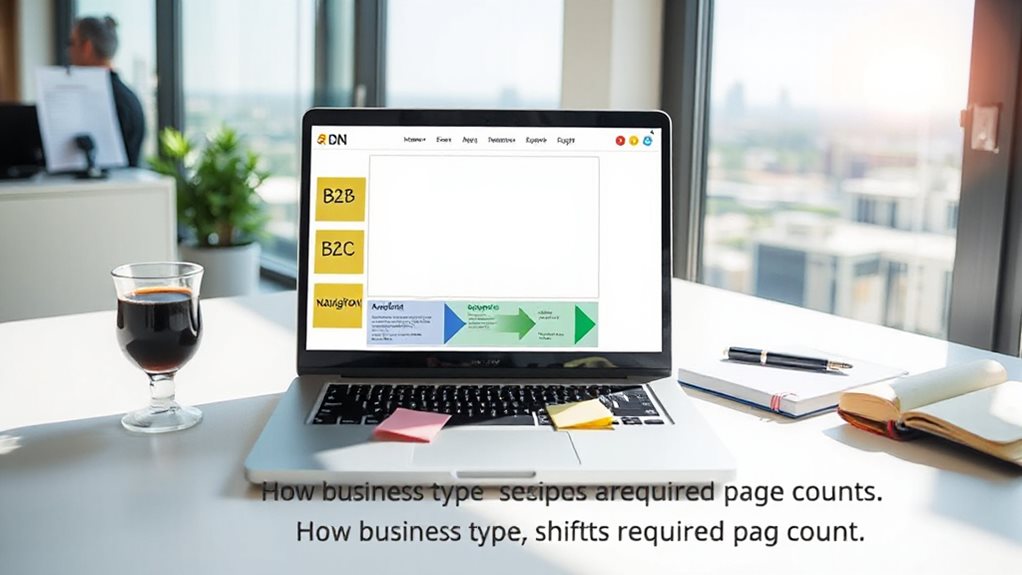
B2B vs. B2C: Why Your Business Type Changes the Math
Here is the original text rewritten with contextually relevant synonyms replacing only the word “navigation”:
When you’re deciding how many pages your small business website actually needs, your business model isn’t just a minor detail—it’s the entire equation.
B2B demands depth: you’re nurturing leads over months, so you’ll need solution pages, case studies, and resources that drive 2-5 pages per session. B2C? Strip it down. Speed wins. I’ve watched B2B sites crush conversions with 20+ strategic pages while B2C flounders with bloated structure chasing single-session sales.
Your 3-Question Page Count Decision Tool
your page count isn’t a guess or a trend to follow. You need three answers.
First, what’s your monthly traffic? Under 15,000 visitors means 5–10 focused pages beat 50 thin ones.
Second, how many pages do visitors actually view? If they’re browsing 4+ pages per session, you’ve earned the right to build deeper.
Third, where does your traffic come from? Organic search visitors expect 5.8 pages of depth; paid search crowds bail at 2.9, so don’t build what they won’t see.
These three questions cut through the noise every time.
And Finally
You don’t need a sprawling site to compete. I’ve seen five well-built pages outperform fifty bloated ones every time. Start with what serves your customers, expand only when traffic and data justify it, and ignore anyone promising magic from sheer volume. Your website’s job isn’t to impress you—it’s to convert visitors. Build accordingly, measure relentlessly, and add pages when they solve real problems, not because you think you should.


