
Local SEO for Trades Businesses: A Practical Blueprint
Your trades business needs five touchpoints working in unison: a complete Google Business Profile with fresh weekly reviews, consistent NAP data across every directory, location pages that answer actual homeowner questions, and schema markup that helps AI systems understand what you do. I’ve seen perfectly good websites lose visibility because someone fat-fingered a suite number or let their profile gather dust. Speed matters too—slow mobile loads kill local conversions before prospects even see your work. Most businesses I audit have at least two of these broken; fixing them isn’t glamorous, but it’s what separates the booked-solid contractors from the ones refreshing their email. The blueprint ahead shows exactly where your gaps likely hide.
TLDR
- Claim and fully optimize your Google Business Profile with complete services, photos, and consistent NAP data across all directories.
- Build multiple touchpoints through GBP, schema markup, and citations to survive AI Overview’s reduced local business visibility.
- Generate one to two fresh reviews weekly for sustained ranking momentum rather than sporadic review bursts.
- Create location pages answering real customer questions with guides, case studies, and video walkthroughs to reduce bounce rates.
- Maintain identical business names and addresses everywhere to avoid Google penalties and profile suspension risks.
Why Most Trades Businesses Lose Local Customers Before the First Call

Why do so many trades businesses watch local customers slip away before they’ve even had a chance to quote? You’re invisible where 92% of local searches become store visits. Your mobile site loads slowly, your Google Business Profile sits half-finished, and your NAP data contradicts itself across directories. Meanwhile, competitors with ten reviews outrank you fourfold. I’ve seen this pattern repeatedly—it’s fixable, but you must stop tolerating digital obscurity. In the trades sector, where customers often need immediate service solutions, your failure to capture that urgent intent at the exact moment of search translates directly to lost revenue before you’ve even entered the conversation. A poorly executed redesign can exacerbate these issues by harming search visibility and causing sudden drops in local rankings.
How Google’s AI Results Show 32% Fewer Businesses (And What That Means for You)
You’re likely noticing fewer calls coming from Google lately, and the data confirms what I’ve seen across dozens of trades accounts: Google’s AI Overviews now surface 32% fewer businesses for local queries, which means your perfectly optimized website mightn’t even reach prospects who need you today. This isn’t a future problem—it’s happening now, and the trades businesses that adapt are protecting their visibility while competitors quietly disappear from results. I’ll walk you through what’s actually changing, how to adjust your strategy without chasing every algorithm update, and why spreading your presence across multiple profiles has become non-negotiable for staying findable. The 2026-2028 timeline indicates this is a gradual but ongoing shift with broader impact across industries, meaning local trades businesses must act now rather than wait for the dust to settle. Improving site performance with practical fixes like image optimisation and caching can also help maintain visibility as search formats evolve.
Shrinking Visibility Reality
they’ll recommend one to three businesses with near-certainty rather than expose you to thirty possibilities. I watched this shift firsthand—my clients who dominated Google’s 3-pack suddenly vanished from AI results. You’re now competing for single-digit slots against tighter criteria. The visibility window narrows dramatically, and “page one” means nothing if the AI doesn’t cite you.
Adapting Your Strategy
That shrinking window I described isn’t just a headache—it’s a fundamental rewrite of how customers find you. I’ve watched trades businesses lose ground because they clung to old playbooks. You need to stop chasing rankings and start building trust signals AI actually reads.
Polish your Google Business Profile obsessively, implement proper schema markup, and create location pages that answer real questions.
Focus on being the business AI confidently recommends, not just the one ranking third.
Multi-Profile Advantage
When Google’s AI Overviews expanded from covering 10,000 keywords to over 172,000 between August 2024 and May 2025, something predictable happened to local visibility: it contracted.
You’re now competing for one of a handful of AI-selected slots, not page-one real estate. I’ve watched trades businesses with outdated profiles vanish entirely while competitors with fresh reviews, complete service lists, and recent photos claim those precious recommendations.
The brutal truth? Google’s AI doesn’t browse; it decides. You need multiple optimised touchpoints—GBP, website schema, directory citations—working in concert because the algorithm’s confidence in your business determines whether you’re shown at all.
When to Pay for Local Calls Instead of Waiting for Organic Rankings
Why wait for organic rankings to deliver calls that might never arrive? I’ve watched proximity barriers crush even well-optimized profiles—your competitor three blocks closer wins the pack despite your efforts. When AI reshuffles local results or ads push organic listings below the fold, you’re invisible. Pay for placement where you don’t rank organically; it’s coverage, not cheating. Page builders and complex site setups can also introduce hidden technical and performance issues that slowly degrade visibility, so consider technical costs when choosing paid placements.
How to Set Up Your Google Business Profile So Customers Actually Find You
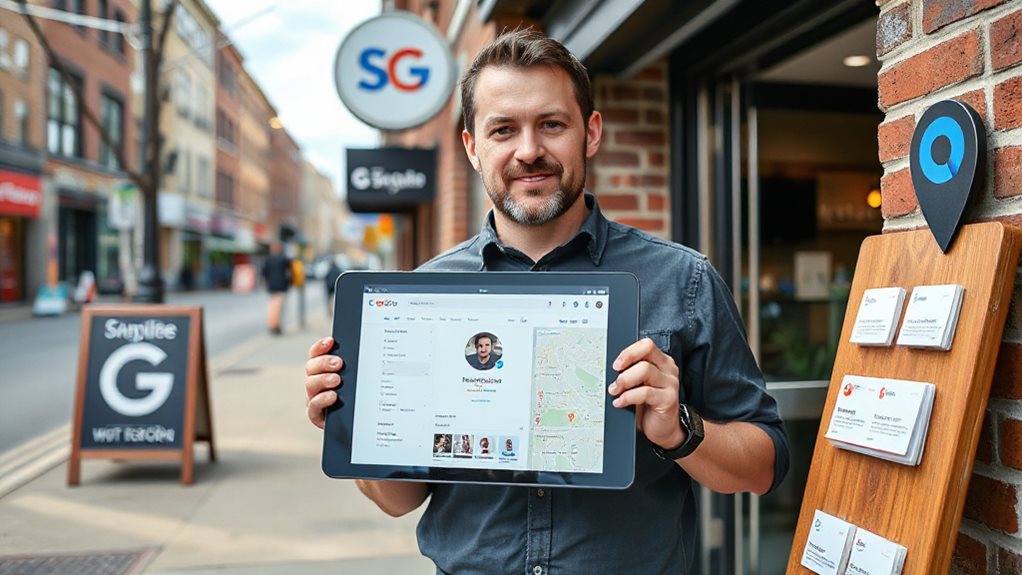
Where exactly does your Google Business Profile sit in the hierarchy of local search success? I’d argue it’s the foundation—everything else builds on this.
Start by claiming your profile at business.google.com, verifying through mail, phone, or email. Choose precise categories like “Electrician” rather than vague alternatives. Add accurate hours, services, and quality photos of your actual work. Skip the P.O. Box; Google checks addresses. Update regularly—stale profiles sink fast. Also, use consistent NAP information and primary categories across platforms to avoid confusing search engines and customers.
Your Local Review Strategy: How Many Per Week Actually Change Rankings?
Once your Google Business Profile is locked down and drawing eyeballs, you’ll notice something quickly: visibility without trust doesn’t pay the bills. Reviews are where the rubber meets the road—15.44% of your local ranking, to be exact. I’ve watched trades businesses obsess over hitting fifty reviews fast, then go silent. That’s backwards.
Three to six weeks of steady activity beats bursts every time. Aim for one to two fresh reviews weekly; the algorithm prefers the “consistent trickle” to occasional floods. Hit ten reviews and you’ll see movement. Keep that pace, or watch your 3-Pack spot slip after three weeks of silence. Simple, unglamorous, and it actually works.
The 4 Website Content Types That Get Homeowners to Stop Comparing and Book

When homeowners land on your site, they’re usually three tabs deep into comparing you against every other electrician or plumber in town, and you’ve got maybe sixty seconds before they bounce back to Google.
You need four content types to stop that comparison spiral: problem-solving guides that answer “how do I fix this,” case studies proving you’ve solved it before, service pages that match exactly what they searched, and video walkthroughs that build instant trust.
Where Your Business Name and Address Don’t Match (And Why Google Punishes You)
Why does your electrician business show up as “Mike’s 24/7 Emergency Electrician Houston Fast” in one directory and “Mike Johnson Electrical Services” in another? You’re confusing Google and customers simultaneously, which takes talent. I see this weekly: stuffed keywords, mismatched addresses, old suite numbers haunting websites like digital ghosts. Google scans your site, finds conflicts, and either rewrites your name unilaterally or suspends you entirely. One location means one listing—creating multiples to “dominate” backfires predictably.
Fix this: audit every directory, match your GBP to your schema markup exactly, and purge old addresses. Your future self will thank you when competitors vanish from results.
And Finally
You don’t need to outsmart Google’s algorithms; you just need to show up consistently where homeowners are already looking. Fix your citations, earn reviews weekly, and write content that answers real questions—most of your competitors won’t bother. I’ve watched trades businesses double their booked calls in ninety days with exactly this approach, no magic required. Start with your Google Business Profile today. Everything else builds from there.