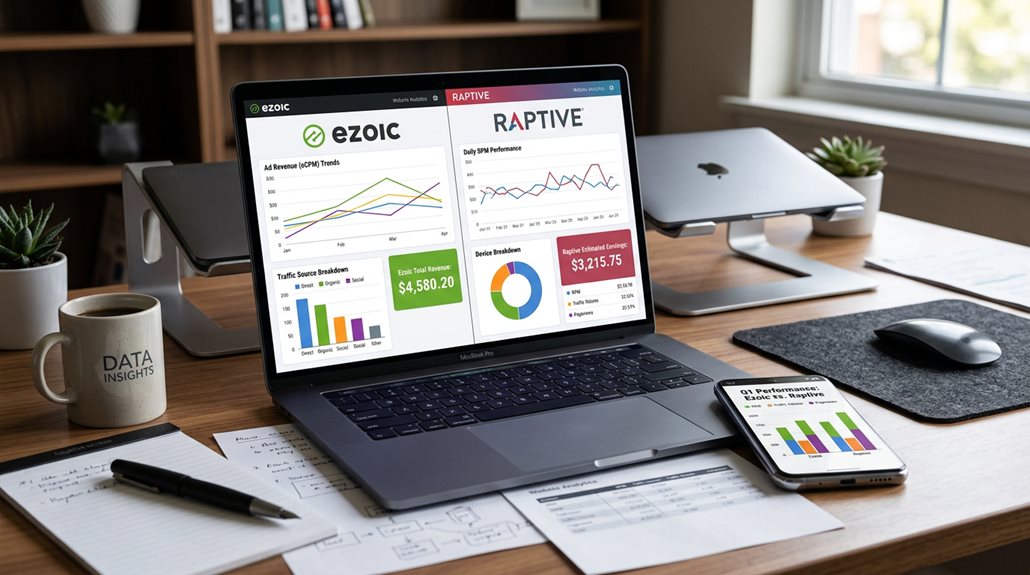
Ezoic vs Raptive: Comparing Ad Networks for Growing Sites
If you’re choosing between Ezoic and Raptive for a growing site, focus on what matters most—ad quality, user experience, and support. Raptive offers cleaner, less intrusive ads with dedicated management, making it ideal if your traffic is already steady and you want premium control. Ezoic’s advanced optimization tools suit sites in early growth but can sometimes compromise site aesthetics or rely heavily on automation. Stay tuned—what follows might help you decide which network aligns with your long-term goals.
TLDR
- Ezoic offers AI-driven optimization with higher revenue share potential but more variability, suitable for early-stage growth sites.
- Raptive provides premium ad placement, cleaner design, and dedicated support, ideal for established, high-traffic sites.
- Ezoic accepts sites with lower traffic and focuses on analytics, while Raptive requires a minimum of 100,000 pageviews monthly.
- Raptive emphasizes user experience and ad quality, reducing clutter, whereas Ezoic’s ad formats can be more intrusive.
- Both networks differ in support and stability, with Raptive offering proactive management and Ezoic providing scalable AI tools.
What Are Ezoic and Raptive?

Ezoic and Raptive are two prominent ad networks that serve very different needs, and understanding their core differences can save you a lot of trial and error. Ezoic is an AI-driven ad platform that uses machine learning for ad optimization. It accepts sites regardless of traffic volume, making it accessible to smaller publishers looking to grow. Raptive focuses on premium publishers with high traffic, offering a fixed revenue share and prioritizing ad quality and site speed. Additionally, automating smart internal linking can enhance user engagement and search engine crawlability, complementing the ad strategies. Recognizing the differences in RPMs and payout terms can help publishers choose the right network for their specific growth stage.
How Do Ezoic and Raptive Differ in Features?
When comparing features, the key difference is how much automation you want versus control.
- Ezoic offers AI-driven ad testing and site speed improvements.
- Raptive emphasizes high-quality ad placement and user-friendly dashboards.
- Ezoic provides advanced ad optimization and analytics tools.
- Raptive focuses on premium demand and strategic ad management.
- Dashboard usability impacts your overall user experience and site speed.
- Incorporating SEO best practices can enhance your site’s visibility and long-term growth. Additionally, understanding how ad network features align with your content strategy can influence your monetization success.
Ezoic vs Raptive: Revenue Potential?
When comparing revenue potential, Raptive tends to deliver more predictable earnings for established, high-traffic sites, thanks to its focus on premium placements and a generous 70% split. Ezoic, meanwhile, offers higher upside with its tiered programs and up to 88% revenue share, but results can be more variable and heavily dependent on site quality and ad demand. In practice, it’s worth remembering that stable income often beats chasing elusive peaks—especially if your site isn’t yet a traffic titan. Incorporating safe AI strategies can help optimize ad placements and content without risking penalties or spam filters. Additionally, understanding ad viewability and how placement impacts revenue can be crucial for maximizing earnings.
Revenue Comparison Details
Have you ever wondered whether a higher revenue split necessarily means more earnings?
- Ezoic’s up to 88% split can enhance ad revenue in high-traffic sites.
- Raptive’s fixed 70% split emphasizes premium ads, often yielding higher RPMs.
- Ad optimization and ad demand influence earnings more than split rates alone.
- Traffic quality and niche affect ad rates and RPM potential.
- Comparing ad network features helps you choose based on traffic and goals.
Earnings Stability Factors
Earnings stability hinges on more than just the revenue split; it’s heavily influenced by the underlying factors that drive ad demand and traffic consistency.
Raptive’s focus on traffic requirements, premium demand, and strict ad network algorithms offers more predictable revenue.
Meanwhile, Ezoic’s ad optimization and RPM fluctuations can cause earnings variability, especially during ad testing or low traffic periods.
What Are the Entry Requirements for Ezoic and Raptive?
Ezoic welcomes sites of all traffic levels, emphasizing site quality and niche, making it a practical choice for beginners or those still building their audience. Raptive, on the other hand, sets a high bar with a minimum of 100,000 monthly pageviews, targeting established publishers seeking premium ad revenue. Understanding these thresholds and quality standards helps you choose the network that aligns with your site’s current stage and long-term goals. Additionally, considering how AI can save time in SEO workflows can help you optimize your site more efficiently as you grow.
Traffic Thresholds and Volume
When evaluating ad network options, understanding their traffic thresholds is essential; after all, you don’t want to waste time on platforms beyond your reach.
- Ezoic accepts sites regardless of traffic volume, no pageview minimum.
- Raptive demands a minimum of 100,000 monthly pageviews for approval.
- Mediavine requires at least 50,000 sessions/month.
- Thresholds influence site growth and publisher eligibility.
- Traffic policies vary, affecting monetization opportunities and site approval.
Content Quality Standards
While traffic volume often steals the spotlight, content quality standards remain a critical gatekeeper for ad networks. Raptive enforces strict publishing standards, emphasizing original, high-quality content that complies with content guidelines for site approval.
Ezoic, meanwhile, focuses on site quality and niche suitability, with less rigid content standards, making it accessible to smaller publishers.
Ad placement and content compliance are key.
Ad Quality and User Experience: Ezoic vs Raptive?
If you’re concerned about maintaining a professional website aesthetic while monetizing effectively, the difference in ad quality and user experience between Raptive and Ezoic is significant.
Raptive offers cleaner ad design, less ad clutter, and well-placed mobile ads, enhancing user satisfaction.
Ezoic’s varying ad quality and intrusive formats can harm your ad aesthetics and overall user experience.
- Seamless ad integration
- Consistent ad formats
- Better ad placement
- Reduced ad clutter
- Enhanced mobile ad experience
Support and Optimization: Comparing Ezoic and Raptive?

Support and optimization are the backbone of effective monetization, yet they often get overlooked in favor of ad formats or revenue algorithms. Raptive offers dedicated account management, strategic guidance, proactive site optimization, and responsive service, resulting in quicker issue resolution and better site performance.
Ezoic’s support can be less accessible, especially at lower tiers, relying more on AI-driven tools than personalized support.
Which Network Is Better for Growing Sites: Ezoic or Raptive?
Choosing between Ezoic and Raptive for a growing site hinges on your current traffic levels and future ambitions.
- Raptive offers higher revenue share for high traffic, focusing on ad optimization and monetization for established sites.
- Ezoic’s scalable platform suits sites in early growth stages, with flexible ad technology and AI-driven management.
- Raptive’s strict thresholds may limit smaller sites, but it excels in user experience.
- Ezoic is adaptable, helping maximize revenue regardless of pageviews.
- Your choice depends on your site’s maturity and traffic volume.
And Finally
Choosing between Ezoic and Raptive depends on your site’s growth stage and specific needs. From experience, Ezoic offers more comprehensive testing tools and a broader feature set, making it suitable for scaling. Raptive might appeal if you prioritize straightforward setup and immediate revenue gains. Remember, no network is perfect—focus on optimizing ad placement and user experience regardless of your choice. Often, the key isn’t the platform but how you utilize its features.