Free vs Paid Analytics Tools: What You’re Actually Missing
Free analytics tools may seem appealing, but they come with significant trade-offs in data quality, customization, and support. You’ll often face limitations like reduced data volume, poor filtering, and little understanding into real-time trends. Paid options deliver reliable, actionable knowledge, along with advanced features like predictive analytics and seamless integration, saving you time and guesswork. If you want smarter decisions and full control over your data, exploring the real differences is worth the effort—your results will thank you.
TLDR
- Paid tools provide advanced features like real-time reporting, AI insights, and higher data limits, unlike basic free options.
- Free analytics often lack data accuracy, filtering, and retention, risking incomplete or misleading insights.
- Paid solutions typically ensure better data security, compliance, and control over data ownership.
- Hidden costs in free tools include time and resources spent on troubleshooting, integration, and data quality issues.
- Paid platforms enable predictive analytics, detailed segmentation, and integration, enhancing strategic decision-making.
What’s the Difference Between Free and Paid Analytics?

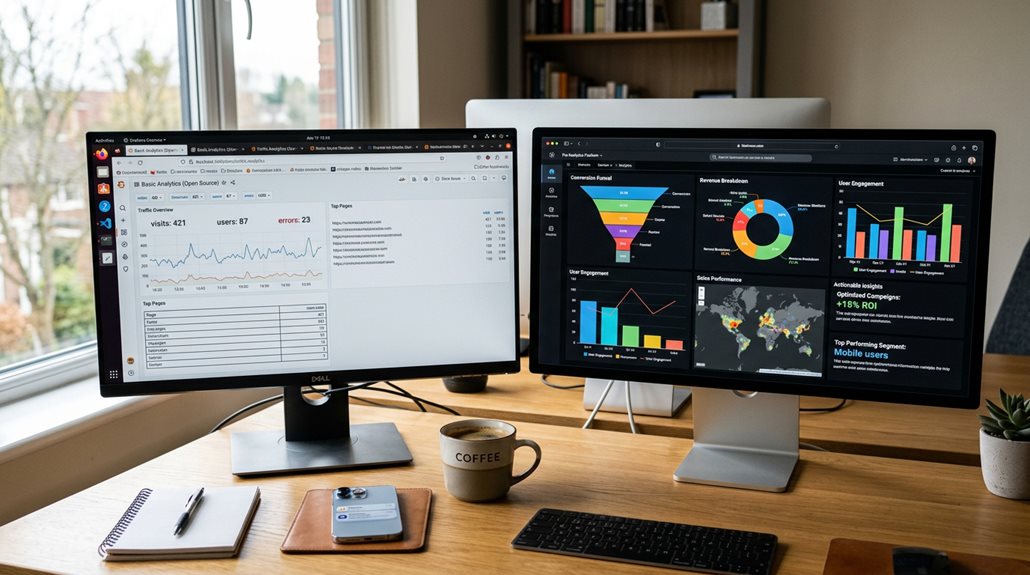
The key difference between free and paid analytics tools boils down to features, reliability, and support.
Free tools often lack real-time reporting, advanced data integration, and customization, which paid options provide. Additionally, paid platforms typically guarantee better data quality, higher data limits, and faster processing.
While free tools suffice for basics, they often fall short for complex analyses and trustworthy data management. The importance of AI-powered insights becomes even more apparent when handling large datasets and ensuring accurate, actionable results.
How Do Free and Paid Tools Impact Data Quality and Insights?
When it comes to data quality and understanding, the tools you choose can make or break your ability to make informed decisions.
- Free tools often limit data filtering and sampling, reducing perspective accuracy.
- Paid analytics provide higher data limits and real-time reports, enhancing data accuracy.
- Limited retention in free tools can cause incomplete understanding.
- Without support, free tools risk data discrepancies.
- Paid platforms improve data governance for reliable perspectives.
- Relying solely on local search rankings can miss valuable insights about customer intent and market opportunities.
- Incorporating market trend analysis can give a more comprehensive view of SEO progress beyond just rankings.
How Do Privacy and Data Ownership Differ in Free vs Paid Analytics?
When choosing between free and paid analytics tools, understanding who owns the data and how accessible it is can make or break your privacy strategy. Free solutions like Matomo give you full control, allowing you to host and export your data without restrictions—think of it as owning your digital backyard. Conversely, many paid options and cloud-based free tools often leave you dependent on vendors who might limit your access or retain rights you never agreed to, which can quietly erode your data sovereignty. Additionally, considering the hosting choices involved in analytics tools can significantly impact your data’s security and compliance. Recognizing the importance of brand search volume and how it influences your visibility can also help you make more informed decisions about data management and strategy.
Data Control and Access
Unlike cloud-based free tools that often limit your data access via API restrictions or sharing policies, self-hosted solutions give you full control over your data.
- You own your data, no strings attached
- Export raw data freely for analysis
- Manage proprietary data securely
- Avoid vendor lock-in with data export options
- Control data access and storage policies directly
This is practical for maintaining data sovereignty and simplifying compliance.
Privacy Protections and Limitations
In the domain of privacy protections, paid analytics tools generally deliver a higher standard of security and compliance because they understand that safeguarding user data isn’t just good ethics—it’s good business.
They offer better data security, compliance with GDPR and CCPA, and features like cookieless tracking.
Free tools often limit data ownership, impose restrictions, and lack rigorous privacy protections, risking data limitations.
What Are the Hidden Costs of Using Free Analytics Solutions?
Using free analytics tools might seem like a cost-effective choice, but the hidden expenses often outweigh the savings. You’ll spend time integrating, troubleshooting, and managing limitations that can lead to compromised data quality, like missed traffic or skewed understanding. Additionally, avoiding common traffic tracking errors requires careful setup, which free tools may not support reliably. In the end, what looks like free might just be a less reliable, more labor-intensive version of paid solutions—sometimes at a surprisingly steep price.
Hidden Implementation Expenses
Implementing free analytics tools may seem straightforward at first, but the real costs often hide behind the scenes. You’ll need technical resources for setup, integration, and ongoing maintenance.
Expect hidden costs like troubleshooting issues, updating codes as your website evolves, and fixing data accuracy problems that can turn into costly re-implementations. These hidden expenses can substantially impact your budget and timeline.
Data Quality Compromises
Relying on free analytics tools might seem like a cost-effective choice, but it often comes with a hidden price: compromised data quality.
Ad blockers and weak bot filtering lead to data inaccuracies, while data limitations restrict long-term analysis.
These issues cause data discrepancies and distort understanding, risking costly business decisions based on incomplete or biased information—something you definitely want to avoid.
What Features and Capabilities Do Paid Analytics Tools Offer?
Paid analytics tools deliver a suite of advanced features that can substantially deepen your understanding of user behavior, often missing from free options.
- Predictive analytics for forecasting trends
- Advanced segmentation for precise audience targeting
- Real-time dashboards for instant insights
- Data integrations with CRM and marketing platforms
- Support for higher data volume guarantees more accurate, thorough analysis, reducing sampling errors and enhancing confidence in decisions.
Should You Upgrade to Paid Analytics? How to Decide?

Deciding whether to upgrade from free to paid analytics hinges on understanding what your current setup can’t do—and whether those gaps are worth addressing.
Paid analytics offer advanced features, faster data processing, and better data accuracy for decision-making.
If free tools no longer meet your needs for detailed segmentation, attribution, or high-volume traffic, an upgrade can provide the understanding you require.
And Finally
Choosing between free and paid analytics isn’t about splurging on features you don’t need or sticking with limited tools. From data accuracy to privacy, the differences matter more than many realize. In real-world terms, investing in a paid solution often yields better understanding, fewer headaches, and clearer ownership. Just remember, the best tool is the one that aligns with your goals and your team’s capacity to interpret the data—no magic bullets here.